

What Does a Mallorn Tree Look Like? A Visual Guide to Seeing Tolkien's Mellyrn in Nature.

"If you really want to know what Middle-earth is based on, it’s my wonder and delight in the earth as it is, particularly the natural earth.” - J.R.R. Tolkien, Niekas Publications, 1966
One of the reasons I find painting from Professor Tolkien's legendarium so satisfying is that he based most of the beauty he wrote about on the natural world, and that is a realm I have been observing with love and fascination since I was a toddler. Some of my earliest memories involve the pine trees and flowers my mother taught me to look at around my first home. Tolkien's "wonder and delight in the earth" is something that is second-nature to me and a deep joy to depict. I want to see what he saw when offering us the superlative sub-creation of the fictitious mallorn and I hope it will be of interest to readers to see the assemblage of seven different real-world trees I draw from in portraying them.
You can't actually see a mallorn, because Tolkien invented them out of his own imagination, but I think you can come quite close by studying these different aspects of Primary World trees.
What Mallorn Leaves Look Like
Tolkien suggested we imagine beech leaves for the shape of mallorn leaves, though larger, and in his own illustration, somewhat narrower. My best guess is that he is referring to England's native Fagus sylvatica. Here is a screenshot of the shape of these leaves from this wonderful video from the Woodland Trust showing a Common Beech throughout the year.

What mallorn leaves should look like is a Tolkien fandom FAQ. I have come across multiple online discussions in which movie-goers are confused that Mr. Jackson portrayed the Mallorn leaf elven brooches the hobbits receive as rather resembling ivy, and these goods have, of course, been mass merchandised. Were these lovely gifts of Galadriel to closely resemble the leaves of her beloved mellyrn, they would likely look something like this detail from one of my paintings of the brooch on Frodo's cloak - with characteristics of the beech leaf, though somewhat longer and narrower, per Tolkien's own drawing:

But we can't confine our vision of mallorn leaves to the beech, because the coloring isn't fully right. Mallorn foliage has a green face and a silver reverse. The leaves I know of that most closely match this description are from the White Poplar, Populus Alba, which quite literally glint like silver when ruffled by breezes:

Populus alba is also a very good tree to think of in imagining the Mallorn leaves when they turn gold, as shown in this screenshot from GardensOnline.com:

There are two other trees I find it helpful to think of when imagining Mallorn foliage color, as well as the gracefulness that might well stop one in one's tracks in seeing either the Primary World trees, or the Secondary World ones. These are Quaking Aspens, Populus tremula, which create a stunning golden display in Europe, or their cousins, Populus tremuloides in the America. One of the first vacations I ever took as an adult was specifically to visit these trees in the California Sierras and there is something most ethereal about their beauty:

The second good tree to consider in imagining the golden foliage is the Lombardi poplar, Populus nigra 'Italica' which is quite common in England and stands like a graceful lit torch in any landscape, as this screenshot from the Southwest Colorado Wildflowers website shows:

A second Tolkien readership FAQ I see relates to whether we should think of fall Mallorn foliage as looking like gold metal or if the author's intent was more poetical than this. I take the latter view. I don't think the leaves looked like jewelry, but many trees have foliage that is highly reflective and shiny, flashing in sunlight. By the same token, I don't believe the silver reverses of the leaves would look like silverware, but I do think they would be evocative of shining, white, brightness, as in the White Poplar foliage.
Professor Tolkien was very fond of this concept of green leaves with silver reverses, and I turned to White Poplar in depicting the tree the elves bring to Aldarion and Erendis as a wedding gift. This tree is not a Mallorn (nor is it the ancestor of the famous White Tree of Gondor) but there are similarities. Here is a closeup of the leaves of that tree from the courtyard in Armenelos where it was planted:

What Mallorn Flowers Look Like
I know of no European tree which has golden flowers that resemble these in Tolkien's own illustration:

He mentioned cherry blossoms in describing the clustered habit of the flowers and as we can see from his illustration, the blooms must have been quite large, given their comparative size to the Mallorn leaves. In zooming in on this drawing, we can see five-petalled flowers with a somewhat tubular shape and darker center.
Taking all this into account, I think it is the flowers of Tabebuia aurea which most closely match the growth habit and color of Mallorn flowers:

Here is a close-up screenshot of their clustered flowers from this excellent video:

And you can see how these blooms influenced my depiction of Mallorn flowers in my painting of Galadriel and Her Weavers in the Golden Wood:

I don't suppose I'll ever know if Professor Tolkien stumbled upon a specimen of the native South American Tabebuia aurea in a public or private collection in England or during his European travels, but I can imagine his delight in encountering one. I was extremely excited when my own research finally led me to this tree that is called "The Tree of Gold."
What Mallorn Bark Looks Like
Silver and smooth are the two adjectives we have for depicting the bark of the mellyrn. The same Woodland Trust video shows us this image of the grey bark of the beech, which is only lightly patterned with texture compared to some trees which have deeply grooved bark:

So, I think the Common Beech is a good start for imagining the bark of Mellyrn, but I also think we can go a little further in imagining its silvery quality. Again, I don't suppose Tolkien intended us to imagine a tree that looked like a stainless steel pillar, but as we know he was already thinking of cherry trees in describing Mallorn flowers, I can't help but think of how some species of cherry have this outstandingly beautiful and near-metallic bark:

A combination of beech bark smoothness and cherry tree bark shine is what guides my own depictions of Mallorn bark.
Imagining the Height and Size of Mallorn Trees
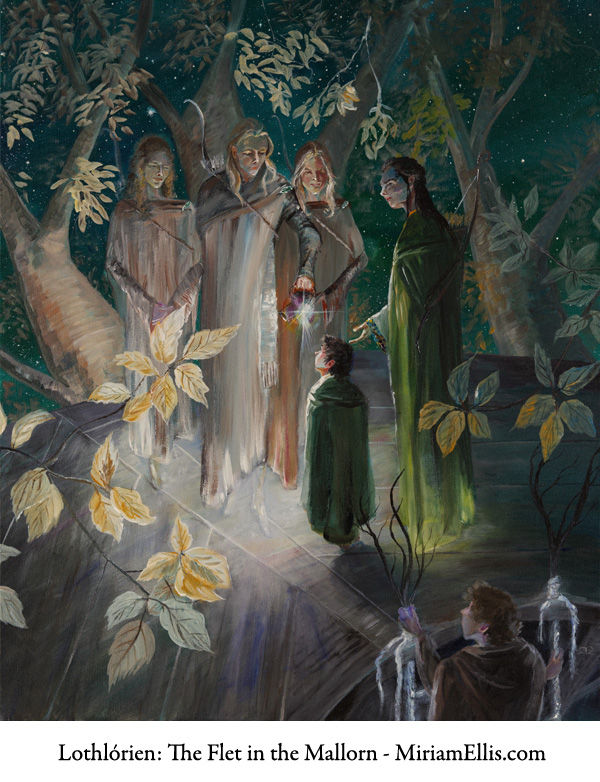
According to Carl F. Hostetter's The Nature of Middle-earth, Númenorean Mellyrn could reach 600 ft. in height, while the later trees of Lothlórien could be about half this size. Not only could they hold the simple flet platforms of the Galadhrim, but whole dwellings and rooms like the reception chamber of Celeborn and Galadriel, my painting of which is seen here ( perhaps appropriately!) on the cover of an edition of The Tolkien Society's journal, Mallorn:

I am truly fortunate to have grown up around California's most famous sequoias, Sequoia sempervirens (the Coast Redwood) and to have repeatedly gone to visit its second most famous, Sequoia giganteum (the Giant Sequoia). The former is the tallest, reaching nearly 400 feet in height, while the latter is about 100 feet shorter but with immense girth and volume. In attempting to portray the size of Mallorn trees, I don't think you can do better than to study these trees:

Tolkien could well have seen them in public gardens in England, where they are prized as a specimen, but I do believe that it's only in experiencing groves of these vast trees in their natural setting that we can get close to the feeling the hobbits might have had in encountering Mellyrn.
Even staid folk tend to wax poetic when seeing sequoia trees, likening them to cathedrals and other wonders. If you are ever so fortunate as to touch one, I think you will know what Frodo experienced in become aware of the life of the Mallorn.
In Conclusion
Each artist will bring their own learning and sensibilities to the portrayal of the magnficent Mellyrn. Tolkien was keenly observant of the natural world, and so I think this is the key to emulating him in depicting Middle-earth. For me, the study of the beech, the various poplars, the tabebuia, and the Redwoods has helped me form a vivid sense of the Secondary World trees of the Professor's loving dreams. I hope this guide has helped you see them a little better, too.


