

Frodo's Authorship: A Work of Effort and Hope
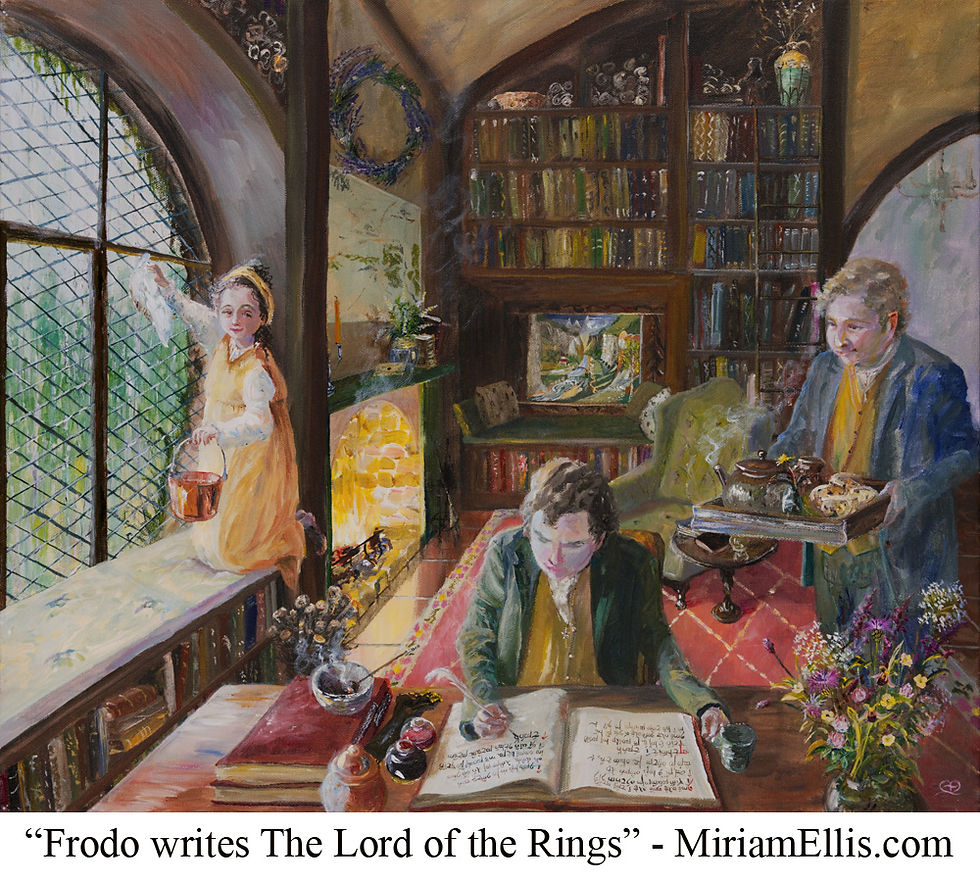
Frodo Baggins was known for his "firm flowing script", and that is a detail I have come to see as remarkable. He returned from Mount Doom with a severely injured right hand. Unless he was left-handed, this means that Frodo wrote what we think of as The Lord of the Rings with a hand he must have had to retrain to write clearly. Consider the difficulty of supporting a quill without the prop of your third finger, and you will quickly realize that one of Frodo's final acts in Middle-earth must have required heroic effort. Indeed, given the length of the tale, this self-sacrificing little hobbit might be seen as a relatable figure by differently-abled folk.
It is a rainy June morning in S.R. 1420, about six weeks after the wedding of Sam Gamgee and Rose Cotton. Bag End is once again comfortable after the depredations of the ruffians, but the normally clear view from the windows atop The Hill is as yet obstructed by overgrown hedges. I expect it would have been some time before Sam had the garden under full management again. The flowers in the room are wildflowers - bee orchids, buttercups, wild carrot, loosestrife, and knapweed.
The newlyweds are doing all they can to take care of Mr. Frodo and his fine smial. Rose washes the windows while Sam appears with tea and scones the moment his master's cup is empty. Frodo is not well, and I suppose that feeding him up might have been an object of the Gamgees in hopes of restoring his lost health. Even the dandelion Sam has jokingly brought in on the tray is meant to cheer up his ailing friend.
I hope you take pleasure in seeing dear Frodo so well looked after as he makes a beginning on his part of one of the red books. He has just reached the episode in which he and Sam and Pippin encounter Gildor Inglorion's folk in the Woody End. He is writing their song to Elbereth in large script with both red and black inks.
In a way, Bilbo is still present in this scene. There are not only his lore books, but a map of his favorite walks over the hearth and a small mural of Rivendell in the reading nook. Frodo assumes Bilbo's legacy in so many different ways, including the sense that these tales should be recorded.
Why do Bilbo and Frodo make this effort? Few of their neighbors care to hear about adventures and prefer books about things they already know. Who were the Bagginses writing for? I've come to believe that their joint authorship is rooted in a fond hope for the future. Perhaps they intuited that one day, there would be hobbits eager to read these stories. If so, they are proved right in the early Fourth Age in which Shire-folk begin to take more of an interest in such things.
I find it good to remember that Bilbo and Frodo took such pains to document their parts in the War of the Ring, and that Professor Tolkien similarly devoted himself as translator. It gives me a feeling of being valued and cared for as a fellow traveler on the shared Road. Can you imagine this study on this cool, quiet morning, and Frodo laboring with his hand? Queen Evenstar's jewel hangs about his neck - a token of both his suffering and the promise of his future healing. I can think of no more important room in Middle-earth than this one under The Hill, given the volumes that emerged from it. Please enter for a moment to honor Frodo's efforts:


